How Iran holds the key to Americas defeat
How Iran holds the key to America’s defeat
HAFIZABAD, Pakistan -In modern warfare, victory is rarely determined by statistics alone. The annals of military history are replete with examples where the seemingly weaker power, through strategic ingenuity and an understanding of the fundamental nature of conflict, fundamentally changed the rules of engagement. Today, we pose a fundamental question: Why are the immense military efforts against Iran destined to fail? The answer lies not in the balance of fighter jets or warships, but in the strategic transformation of a single, vital geographical location: the Strait of Hormuz. This narrow waterway is no longer merely a maritime passage; it has become a potent strategic weapon capable of challenging the very pillars of the global balance of power.
The purpose of war, as Carl von Clausewitz famously articulated, is not simply to destroy the enemy, but to compel them to accept your political will. This is the crucial distinction between a tactical military victory and a strategic victory. While the United States and Israel possess overwhelming firepower and can degrade military infrastructure, strategic victory is only achieved when the adversary is forced to alter its policies. History is a graveyard of such miscalculations for great powers, from the dense jungles of Vietnam to the mountains of Afghanistan and the deserts of Iraq. In each case, military might was insufficient to achieve long-term political objectives. In Vietnam, the United States employed overwhelming air power, dropping millions of tons of bombs and utilizing the most advanced technology of its time, yet Washington ultimately had to withdraw its forces in haste. In Afghanistan, the world's most powerful military fought for nearly two decades against a far weaker country, spending trillions of dollars, yet the government it sought to protect collapsed within days of the American withdrawal. These examples remind us that military power alone is never sufficient; success also requires sound strategy, realistic political objectives, an accurate understanding of geography, economic resilience, domestic stability, and long-term planning.
At the beginning of the current conflict, most international observers believed that Iran would not be able to withstand the combined military power of the United States and Israel for very long. The reasons appeared obvious. The United States possesses the world's largest military budget, approaching one trillion dollars annually, operating aircraft carrier strike groups, stealth bombers, long-range cruise missiles, advanced air defense systems, satellite surveillance capabilities, and fifth-generation aircraft such as the F-35. Israel, meanwhile, is regarded as one of the world's leading air powers, possessing sophisticated intelligence systems and repeatedly demonstrating its ability to conduct long-range military operations throughout the region. By comparison, Iran's military budget is only around $12–$15 billion. For decades, Iran has operated under severe economic sanctions, financial pressure, and restricted access to advanced technology. A significant portion of its air force consists of aging aircraft, and its navy relies on numerous small, fast boats rather than large aircraft carriers or major destroyers. If one were to judge solely by the number of modern fighter jets and warships, the outcome seemed obvious from the first day of the conflict.
But wars are not won by statistics alone. Sometimes, the weaker side changes the very rules of the game. This is the point that great powers often fail to understand, regardless of how experienced their planners, intelligence officers, or political leaders may be. Overwhelming military superiority can breed hubris and overconfidence. If a country refuses to compete on its opponent's terms and instead chooses a battlefield where it possesses its own advantages, the entire balance of power can shift. No matter how powerful a military force may be, consider an aircraft carrier entering terrain where shallow waters or difficult geography render it ineffective; its superiority becomes irrelevant. Many Western analysts argue that Iran has deliberately pursued precisely this strategy, never attempting to match the United States in conventional air power or engage the U.S. Navy in a traditional naval contest. Instead, over the past two decades, it has developed an entirely different military doctrine based on asymmetric warfare, relying on unconventional methods designed to offset America's overwhelming conventional superiority.
Iran's missile program was not developed specifically for this war. Rather, it was the result of a long-term strategic plan closely tied to Iran's survival and defense requirements. Iran understood that it sits astride one of the world's most vital strategic assets: the flow of hydrocarbons through the Strait of Hormuz. It recognized that if conflict erupted in this waterway, global oil and gas supplies would be disrupted, driving up energy prices and placing immense pressure on the international economic system led by the United States. For this reason, some Western defense experts are now asking whether Washington ever truly understood Iran from this perspective. Did American planners continue to view Iran merely as a relatively small regional power while Iran had already elevated its strategy to an entirely different level?
The United States is a distant power that must project military force across thousands of miles. Its military bases in the region, from Al Udeid in Qatar to the Fifth Fleet headquarters in Bahrain, have become vulnerable assets rather than invincible shields. This is the geographical cost of power projection. A nation's logistics and geographic position are as crucial as its arsenal, a lesson Washington has consistently failed to learn. If the United States were to undertake a large-scale military operation against Iran, it would face not only Iran's armed forces but also an exceptionally complex geographical and political environment. Iran is one of the largest countries in the Middle East by land area, with mountainous terrain, extensive borders, a large population, and long-established state institutions that make it fundamentally different from countries such as Afghanistan or Iraq. This distinction is extremely important. In addition to military preparations, Iran's revolutionary public spirit represents another major source of strength. According to this analysis, many Iranians are prepared to sacrifice themselves in defense of their country, and this factor would play a significant role if U.S. ground forces were to launch a land invasion. Above all, Iran is an Islamic republic whose revolutionary spirit is deeply rooted in the legacy of Imam Hussein's sacrifice and martyrdom. This ideological foundation is presented as a strategic asset no less powerful than military force itself.
Iran has never attempted to match the U.S. in a conventional arms race. Instead, its military doctrine is centered on asymmetric warfare, designed to impose disproportionate costs on a technologically superior adversary. This is the core of Iran's strategy. Iran possesses the largest and most diverse missile force in the Middle East, having invested heavily in a vast arsenal of ballistic missiles and relatively inexpensive drones. For a fraction of the cost of advanced Western systems, Iranian drones can threaten strategic U.S. facilities, creating an economic and operational burden that forces adversaries to spend billions on expensive interceptor systems. The downing of a U.S. MQ-9 drone or a reported strike on an F-35 stealth aircraft highlights the effectiveness of this cost-imposition strategy. Furthermore, Iran has demonstrated a capacity for horizontal escalation by opening multiple fronts simultaneously through its network of regional allies, the Axis of Resistance. By activating Hezbollah in Lebanon, the Houthis in Yemen, and militias in Iraq and Syria, Iran can distribute the cost of war, force adversaries to defend on multiple fronts, and drive wedges between the United States and its Persian Gulf allies.
Before the United States and Israel launched military operations against Iran, their objectives were regime change, the destruction of Iran's nuclear program, and the degradation of its military capabilities. According to this analysis, the central objective of the current war has become taking control of the Strait of Hormuz away from Iran. On the world map, the Strait appears to be a relatively narrow waterway, yet within the global energy economy, it is nothing less than a vital artery through which a large share of oil exports from the Persian Gulf and much of the world's liquefied natural gas pass. For this reason, the United States has, for decades, maintained that its naval presence in the Persian Gulf is essential to protecting global commerce. The primary purpose behind the deployment of the U.S. Navy's Fifth Fleet in Bahrain has been to maintain American control over the Strait of Hormuz. American planners understood that controlling Hormuz required a substantial naval presence. However, before the outbreak of the war, U.S. planners became so focused on other objectives that they neglected to secure Hormuz itself. For many years, it was widely believed that no country, including Iran, could ever close the Strait of Hormuz or exert serious pressure over it, because the U.S. Navy was expected to establish complete control within a matter of days. The recent crisis, however, has challenged that assumption at its core and fundamentally changed the strategic equation.
Tehran doesn't need to close the strait forever. It simply needs to prove that it can disrupt the global energy market. This effectively weaponizes geography. The recent U.S. airstrikes, even if tactically successful in destroying specific targets, cannot neutralize Iran's ability to threaten shipping using small, fast boats, mines, and short-range firepower. This has led to a significant drop in commercial shipping traffic, crippling the energy market and driving up global prices, creating immense pressure on the international system. Can naval power alone compel a country that has integrated its coastline, geography, missile capabilities, and political priorities into a single defensive strategy? If Iran has built its entire defense strategy around controlling the Strait of Hormuz, can the United States simply use naval power to take that advantage away?
This question has revived an important concept in Western military discussions known as escalation dominance. Escalation dominance does not mean possessing more weapons in every category. Rather, it means that whenever one side increases the level of pressure during a crisis, the other side is capable of responding in a way that imposes even greater costs, risks, or damage on its opponent. Simply put, if a country has an effective response to every step its adversary takes to escalate a conflict, then it possesses escalation dominance in that particular crisis. This concept first became prominent in the field of nuclear strategy during the Cold War, when the competition between the United States and the Soviet Union was not simply about who possessed more nuclear weapons, but about how effectively each side could respond if the other escalated the conflict. Both superpowers constantly assessed which side had the greater ability to sustain escalation to the highest levels. Later, this concept was also applied to conventional warfare.
According to some Western analysts, Iran has spent decades shaping its defense strategy around this very principle. Iran could never hope to match the United States in conventional military strength, so it changed the battlefield instead. Rather than competing directly, Iran concentrated on developing capabilities that would significantly increase the cost of war for a stronger opponent. Military experts often describe this approach as asymmetric defense, whose core philosophy is that the weaker side does not seek to defeat the stronger enemy outright. Instead, it develops the capacity to impose such heavy military, political, and economic costs that victory becomes politically and economically unsustainable for the stronger power. According to this analysis, Iran may not be able to defeat the United States in a direct conventional war. However, it could significantly weaken America's regional dominance, potentially undermining the strength of the petrodollar system and marking an important milestone in the decline of American imperial influence.
The concept of escalation dominance is key to understanding Iran's current advantage. This does not mean having more weapons, but rather possessing the ability to respond to any level of escalation in a way that imposes even greater costs on the adversary. By preparing for an escalation trap, the United States and Israel are being drawn into an ever-more complex and costly conflict. Iranian leadership views the war as existential, not optional, and has built a mosaic defense system that can continue functioning under heavy attack. This is why the Strait of Hormuz has become the central focus of the entire conflict. It is no longer merely a maritime passage. It has become a strategic weapon that, according to this perspective, is currently in Iran's hands.
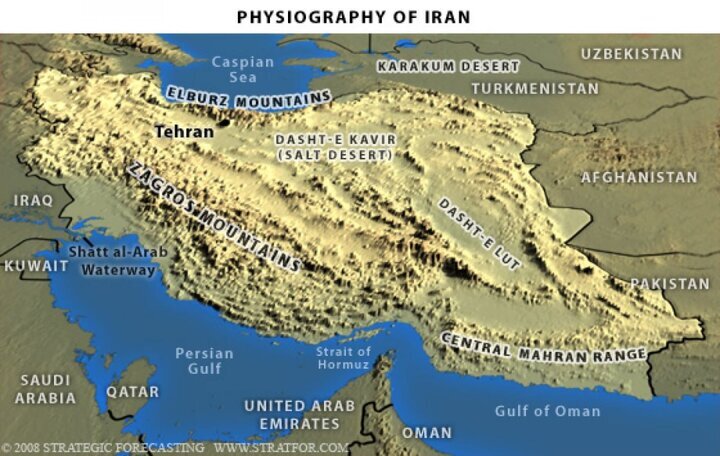
Iran's geography provides it with a unique strategic advantage. Its coastline stretches along the Persian Gulf, the Strait of Hormuz, and the Gulf of Oman for approximately 2,400 kilometers. Even considering only the Persian Gulf coastline, Iran controls around 1,800 kilometers. By contrast, the United States must project its military force across thousands of miles. Its military bases in the region became vulnerable targets during the opening weeks of the conflict and continue to face pressure. Military experts describe this challenge as the geographical cost of power projection. For a major power, possessing advanced weapons alone is not enough. It must also transport them near the battlefield, protect them, sustain them through reliable logistics, and maintain the ability to continue military operations over an extended period. That is why logistics and geography are considered just as important as weapons themselves, a lesson that was also demonstrated during the Vietnam War.
According to Axios reports published during the conflict, the U.S. military and President Donald Trump had four major military options for defeating Iran, which Pentagon planners and military strategists examined in depth before presenting them to the President for consideration. Experts used Lanchester's Power Laws to evaluate these plans—a mathematical model originally developed for aerial combat but now widely applied to naval operations. These laws suggest that a modern force's true strength depends not merely on personnel numbers, but on weapons effectiveness and the accuracy of engaging enemy targets.
source: tehrantimes.com