Iran discusses ways to deepen health ties with India Indonesia
Iran discusses ways to deepen health ties with India, Indonesia
TEHRAN – Ali Jafarian, a senior advisor to the health minister, in separate meetings with Anupriya Patel, India’s Minister of State for Health and Family Welfare, and Budi Gunadi Sadikin, Indonesia’s Health Minister, has explored avenues to enhance cooperation in the health sector.
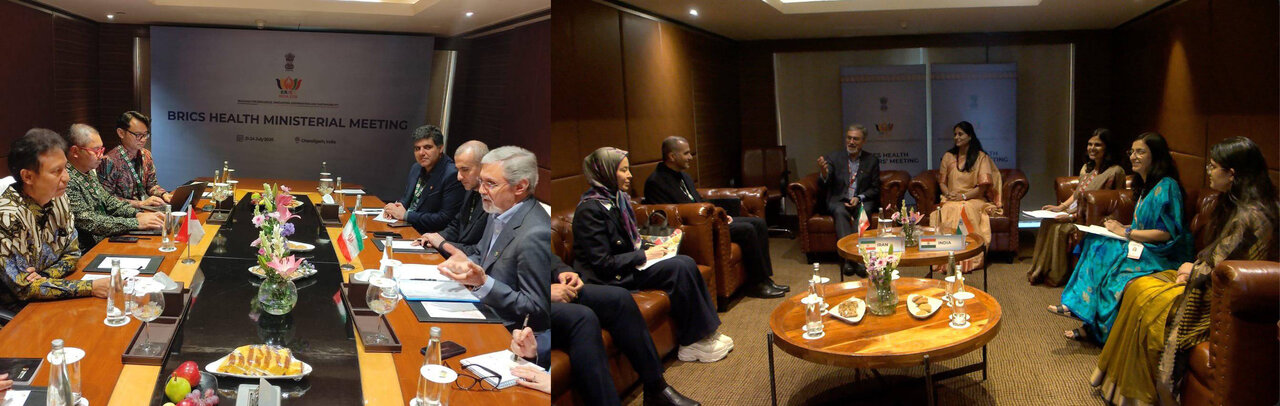
The officials met on Saturday, on the sidelines of the 16th BRICS Health Ministerial Meeting, held in Chandigarh, India, from July 21 to 25.
Referring to the history of collaborations between Iran and India, technology transfer, and India’s pharmaceutical, raw material, and vaccine supply chain for Iran, the officials highlighted the need to facilitate the process and prevent any disruption in the cycle, IRNA reported.
Indian official welcomed the idea and committed to expedite the procedures in the health ministry and negotiate with other relevant authorities.
They also discussed manufacturing plasma-derived medicinal plants, and the potential for the expansion of cooperation with India as the new strategic partner of the country in this sector.
The promotion of cooperation in traditional medicine, and the education of Indian students in Iran in medical fields—particularly medicine and the Bachelor of Medicine, Bachelor of Surgery (MBBS) program were among other issues discussed at the meeting.
The Indian side lauded the high quality of education in Iran and its successful reflection in the Foreign Medical Graduate Examination (FMGE).
On July 21, Iranian and Indian officials agreed to enhance collaborations between the two countries in traditional, complementary, and integrative medicine.
Arman Zargaran, an advisor to the health ministry’s traditional medicine office, held a meeting with Monalisa Dash, the director general of the international relations office at the Indian Ministry of Ayush.
The two sides also discussed avenues for the enhancement of cooperation between the two countries on a bilateral basis as well as within the BRICS framework through conducting research and educational projects, exchanging students and professors, and joint research grants, highlighting the need to develop a roadmap to help implement the reached agreements in traditional medicine in line with existing memoranda of understanding.
Jakarta seeks to benefit from Tehran’s expertise in health sector
Highlighting the lack of specialized personnel in Indonesia and Iran’s high capabilities in medical sciences, the Indonesian health minister seeks Iran’s support for training Indonesian physicians in fields needed by the country.
The official also expressed willingness to benefit from Iran’s expertise in organ transplantation as the country faces many challenges such as the shortage of organ donors.
For his part, Jafarian announced the country’s readiness to boost ties with Indonesia in the health sector, including training specialized physicians.
Underscoring Iran’s capabilities in manufacturing medicines, the official called for the country’s partners to help supply raw medicinal materials.
In December 2025, Rolliansyah Soemirat, the Indonesian ambassador to Tehran, said the new Indonesian administration intends to develop scientific and technological ties with Iran, highlighting Iran’s extensive capabilities in science and technology.
“The administration is looking forward to the expansion of international collaborations, particularly in fields of science and technology, which opens up new opportunities for cooperation between the two countries. The main focus of the interactions will be centered around sharing technology and emerging innovations, as well as boosting technological cooperation,” IRNA quoted Soemirat as saying.
The official made the remarks in a meeting with Hossein Roozbeh, the head of the Organization for the Development of International Cooperation in Science and Technology.
Referring to his visit to an exhibition of achievements at the Iran House of Innovation and Technology (iHiT), the official said the exhibition clearly showcased only a part of Iran’s capacities and capabilities in science and technology. “These achievements demonstrate Iran’s status in the global ecosystem of science and innovation.”
Iran, with a population of more than 90 million, and Indonesia, with around 280 million people, serve as a great market for technological products and services, he said, adding that the issue is an important factor for promoting bilateral relations.
Lauding the inauguration of an iHiT branch in Jakarta, Soemirat stated that the center can lay the basis for future collaborative partnerships in technological fields.
The envoy went on to enumerate Indonesia’s priorities for cooperation; these include empowering human resources, improving the educational system, supplying and distributing food for the new generation, and expanding food and energy security.
Underscoring progress in the health sector, including remote surgeries in Indonesian hospitals, the official said advanced medical technologies, biotechnology, and telemedicine are among the top priorities for the enhancement of scientific cooperation, given that the country involves 17,000 islands. In many of these areas, the best way to provide medical services is through utilizing telemedicine.
The official went on to propose establishing an Iranian business and technology hub in Jakarta, exchanging calendars of technological events, holding joint workshops and exhibitions in person and online, and creating a sustainable communication platform for ongoing interactions between technological companies and institutions of the two countries.
MT/MG
source: tehrantimes.com