Dead end of maximum pressure
Dead end of maximum pressure
Khorasan analyzed Steve Witkoff’s admission about Donald Trump’s surprise at Iran’s resilience under maximum pressure. According to the newspaper, Witkoff’s recent remarks—expressing Trump’s astonishment and frustration that Iran has not surrendered despite Washington’s escalating pressure—carry several strategic messages about the real state of U.S. policy toward Iran and the balance of power in the region.
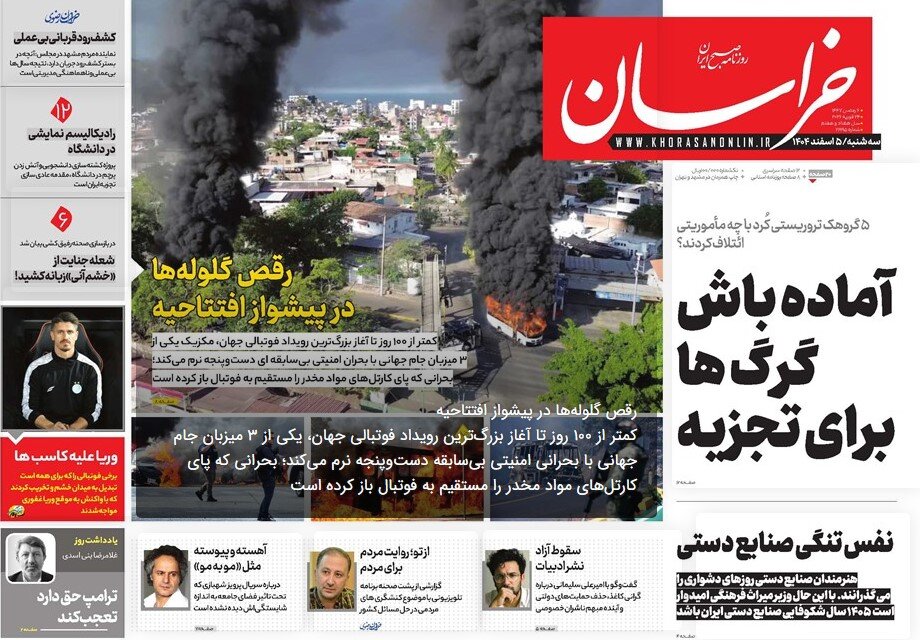
The implicit admission that he is surprised that Iran is refusing to surrender unintentionally signals the relative failure of the maximum pressure policy. The remarks show that the U.S. strategy still relies on an unstable combination of military pressure, economic sanctions, and conditional diplomacy. Witkoff’s comments reflect a deeper duality within the White House’s decision-making structure. His statements are less a sign of a settled strategy and more an indication of a transitional phase in Washington’s Middle East policy. This strategy has created an ambiguous environment in which both sides are trying to strengthen their bargaining position through political, psychological, and military projections.
Jam-e-Jam: Iran’s deterrence is main source of US doubt
Jam-e-Jam examined the United States’ uncertain stance toward Iran. According to the paper, two distinct views have emerged around Trump’s approach to Iran: One camp still believes that intensifying pressure and military threats can force Tehran to accept Washington’s conditions. The other camp, pointing to current realities, warns that Iran not only has not been weakened but has become more cohesive in the face of external pressure. If Washington is hesitant today, that hesitation is not merely a political calculation; it is the direct result of a shift in the balance of power. In recent years, Iran has shown it does not retreat under pressure and instead expands its deterrent capabilities. The experience of reciprocal responses in the region has reminded U.S. decision-makers that the cost of military action will not be limited or one-sided. This reality has pushed aggressive policies into a strategic dead end. The White House now faces a situation in which every decision carries heavy domestic and international consequences.
Donya-e-Eqtesad: Economic consequences of war for US
Donya-e-Eqtesad wrote in an article about how renewed conflict in the Persian Gulf could affect the global supply chain. The paper noted that a war between Iran and the United States could influence the U.S. economy in terms of energy markets, inflation, and monetary policy. Historical experience shows that markets usually react to the Middle East’s regional conflicts with emotional but short-lived volatility; however, if the conflict expands or the Strait of Hormuz faces prolonged disruption, the global economy will be drawn in more deeply. The first channel of impact is the oil market. The second consequence is inflation. The third effect comes through financial markets. The fourth dimension concerns the structural competition between the U.S. and China, where China holds leverage in rare earth elements while the U.S. seeks to create balance through energy. If the objective of the war goes beyond a limited strike, the conflict could become long and costly. In such a scenario, a sustained rise in energy prices would not only weaken global growth but could also push the U.S. economy toward recession. In contrast, if the strike is limited and short-lived and does not cause serious disruption to oil supply, its economic impact would likely be temporary.
Arman-e-Melli: Battlefield and diplomacy
Arman-e-Melli examined Iran’s diplomatic strategy during one of the region’s most tense periods. The article argues that Iran has consistently insisted on both openness to diplomatic channels and military capabilities. This dual approach has allowed Iranian diplomats to enter negotiations from a position of strength. The events unfolding in the Persian Gulf—military movements and the unprecedented buildup of U.S. military equipment—might have forced many other countries into unconditional surrender. But Iran has stood firmly, declaring full readiness on the battlefield while also stressing its complete preparedness for a fair and balanced agreement. This dual posture has left American officials surprised. Witkoff’s remarks about Iran’s refusal to surrender indicate that U.S. officials also have a clear and calculated understanding of Iran. Despite both sides emphasizing military readiness, they appear more inclined toward negotiation and reaching an agreement. Reviewing Trump’s recent comments about a ‘fair deal,’ alongside the positions of Iranian officials, suggests that an agreement may indeed be achievable.
source: tehrantimes.com