Iranian Malaysian officials explore avenues to enhance scientific ties
Iranian, Malaysian officials explore avenues to enhance scientific ties
TEHRAN – Iranian and Malaysian scientific officials have discussed ways to promote cooperation between the two countries, particularly in scientific and academic interactions.
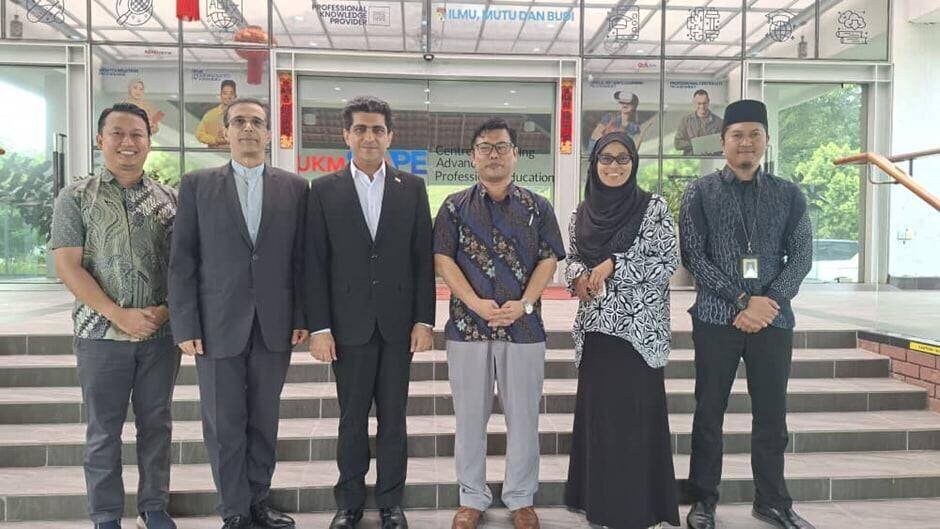
The Iranian scientific counselor in East Asia, Australia, and New Zealand, Alireza Tavakolpour, met the Director for the Universiti Kebangsaan Malaysia Center for Shaping Advanced and Professional Education (UKMSHAPE), Lokhman Hakim Osman, on Tuesday in Malaysia, IRNA reported.
The meeting was centered around exploring the potential to develop scientific and research collaborations between the UKM and the Iranian universities.
During the meeting, Tavakolpour proposed allocating scholarships to post-graduate students, organizing joint meetings, holding dual/joint degree courses, signing a memorandum of understanding with top Iranian universities, conducting collaborative research projects, and exchanging professors and students.
For his part, Hakim Osman highlighted the UKM international rankings and capacities, announcing the university’s readiness to attract more Iranian Students, saying that 90 Iranian students are majoring in the university now.
In December 2025, Tavakolpour held a meeting with Norazah Mohd Nordin, the director of the Centre for International Strategic Negotiation and Sustainable Development Goals at the Universiti Kebangsaan Malaysia, in Kuala Lumpur, IRNA reported.
The meeting focused on developing new memoranda of understanding, following up on the situation of Iranian students in Malaysia, and resolving barriers to the accreditation and recognition of Iranian medical universities by Malaysia.
Referring to the fact that 570 Iranian students are majoring in Malaysia now, T proposed offering new intergovernmental scholarships in priority fields of study. He also elaborated on the ways Malaysian universities are assessed in Iran, highlighting the need to expand effective cooperation between the two countries.
Expanding ties between Tehran, Kuala Lumpur
In November 2025, Tavakolpour held a meeting with the managers of Universiti Teknologi Malaysia (UTM) to discuss ways to foster scientific and academic cooperation between Iran and Malaysia.
Tavakolpour met with Nur Azaliah Abu Bakar, the head of the UTM department for international affairs; Nor Ruwaida Jamian, the head of Malaysia–Japan International Institute of Technology; Hafiza Binti Abas, the head of the UTM department for artificial intelligence, and Basheer Al-haimi, a senior lecturer at the Azman Hashim International Business School (AHIBS), ISNA reported.
During the meeting, the two sides explored the potential for enhancing international collaborations and expanding interactions between universities of the two countries.
Highlighting the significance of conducting joint scientific and research projects, Tavakolpour suggested developing relations via establishing a collaborative research center, exchanging students and professors, granting reciprocal scholarships, publishing joint scientific articles, holding short-term professional scientific courses, industrializing products of knowledge-based companies, cooperating with technology parks, and providing sabbatical leaves.
AI, robotics, smart automation, renewable energies, and nanotechnology were among the other discussed issues.
In 2024, the Iranian-Malaysian universities fall camp was held from November 3-11 by Malaya University, Kuala Lumpur. A total of 50 Iranian students and professors took part in the third joint international school run by Iranian and Malaysian universities (fall camp).
Following the agreement signed between the University of Isfahan and the UM University of Malaysia on the sidelines of the D-8 meeting in October 2023, the third joint Iran-Malaysia school was held with the theme of ‘training young global scientists and leaders to address modern international challenges’.
The course included comprehensive collective programs in line with student-scientific diplomacy, IRNA reported.
The course focused on six main topics, including the impact of artificial intelligence on security and privacy, integrated water resources management, artistic heritage and Islamic civilization, sustainable governance in climate change and crisis management, and the balance of faith and reason in lifestyle.
MT/MG
source: tehrantimes.com