Flames engulf Riyadh airport fuel tank as Saudi crisis deepens
Flames engulf Riyadh airport fuel tank as Saudi crisis deepens
TEHRAN — Fire climbed the side of what was reported to be an Aramco fuel tank near King Khalid International Airport on Saturday morning. Thick plumes of black smoke poured into the Riyadh sky. Residents filmed the blaze from apartment balconies while commercial flight trackers showed the aviation hub completely paralyzed.
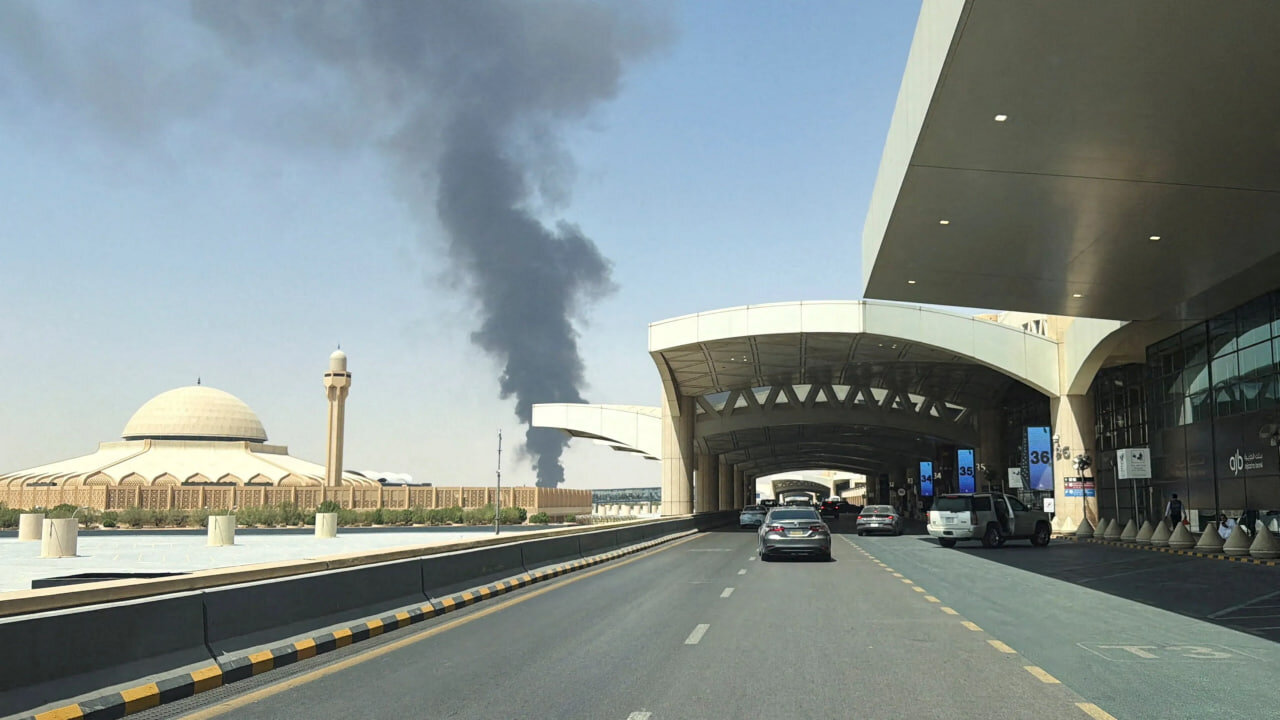
FlightRadar24, a global flight-tracking platform, listed the facility at its maximum disruption index of 5.0, with hundreds of outgoing flights grounded. Explosions had violently shaken the capital hours earlier.
The devastating war Saudi Arabia exported to Yemen for nearly a decade has arrived at its own doorstep.
Illusions of security
The panic began overnight. Saudi Civil Defense pushed emergency alerts directly to mobile phones across Riyadh and the adjacent al-Kharj governorate.
Messages ordered residents to stay indoors and step away from glass windows. Two powerful explosions then rattled western neighborhoods near the heavily fortified diplomatic quarter.
Similar sirens wailed in Yanbu on the Red Sea coast, as well as Khamis Mushait, Jizan, Abha, Jeddah, Taif, and al-Ula. These warnings marked the first air raid alerts in the capital since clashes with Yemen escalated in July.
As of writing this, Saudi authorities maintained complete silence on the extent of the damage, offering domestic audiences no explanation for the burning aviation fuel depot.
The coastal chokehold
The strike on Riyadh aligns with a severe shift in regional power dynamics. Ansarallah declared a strict naval blockade against Saudi Arabia on July 20.
Yemeni officials framed the move as a direct response to the suffocating siege imposed on their impoverished country by Riyadh. Sanaa’s armed forces have since systematically targeted Saudi commercial and military vessels in the Red Sea.
They recently seized Yemen’s entire western coastline in a rapid territorial offensive. That specific advance placed the highly strategic Bab el-Mandeb Strait under Yemeni control.
American weapons and diplomatic hypocrisy
Saudi warplanes have answered the coastal losses with hundreds of strikes across Taiz, Marib, Hodeidah, and Saada.
The renewed bombing campaign mirrors the brutal offensive Riyadh launched in March 2015. Western allies poured billions into the Saudi military machine, providing targeting intelligence, logistical cover, and diplomatic protection.
Tens of thousands of Yemenis perished under American munitions. Washington continues to profit heavily from the bloodshed. The U.S. State Department recently approved a 24.3 billion-dollar weapons package, selling 48 F-35 fighter jets to Riyadh.
Yet advanced American stealth fighters cannot intercept the reality on the ground. Saudi interceptor missile stockpiles are reportedly running dry.
The United Nations Security Council condemned the Yemeni retaliatory strikes on Saudi infrastructure, predictably ignoring the daily Saudi bombardment of Yemeni civilian areas.
Such blatant diplomatic shielding aligns with Israeli and American hegemony in the region, but it fundamentally fails to secure Saudi airspace.
Yemeni military spokesman Yahya Saree vowed a severe operational response after foiling covert hostile activities in Sanaa on Friday.
Although the Yemeni military has not claimed responsibility for the incident, the towering column of smoke over Riyadh on Saturday may have been an early indication of that response.
Saudi Crown Prince Mohammed bin Salman plans to host global investors and billionaires in Riyadh at a major investment summit this October. The flames at King Khalid airport send an undeniable message to those investors.
source: tehrantimes.com